Who Are the Top Acoustic Wall Panel Suppliers in China?
Choosing a Chinese supplier for a Panel Acoustic Wall is not just a price comparison. Buyers need to check sound-absorption test results, core materials, edge details, fire documentation, production capacity, and export experience. Small differences matter. A neat sample can hide uneven density or rough edges once panels cover a full meeting-room wall.
The 2023 Global Status Report for Buildings and Construction, published by UNEP and the Global Alliance for Buildings and Construction, reports that buildings and construction generated 37% of global energy- and process-related carbon dioxide emissions in 2022. That figure does not measure acoustic-panel demand. It does, however, make material sourcing and documented product claims important parts of construction procurement. Ask suppliers for current test reports, not only product brochures.
Sound consultant Julian Treasure has said, “We are losing our listening,” in his TED talk on listening. His observation is a useful reminder: a wall panel should support the room’s purpose, not merely decorate it. Still, no panel can correct every acoustic problem alone. Room shape, ceiling height, furnishings, and installation all affect results. A supplier that explains those limits may be more credible than one promising perfect silence.
This guide examines Chinese suppliers through practical criteria: product range, customization, quality evidence, communication, and delivery capability. Use the shortlist as a starting point, then verify claims against project specifications. And inspect a real sample. Images can flatter.
What Acoustic Wall Panels Are and How They Work
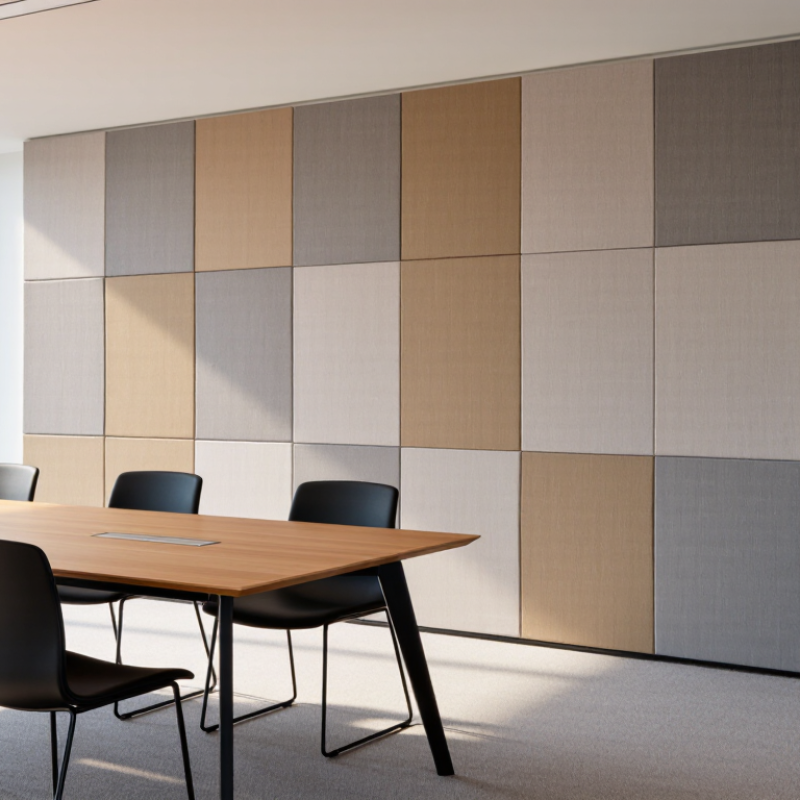
Acoustic wall panels are designed to absorb part of the sound energy inside a room. They are commonly made with porous cores, such as mineral fiber or acoustic foam, covered by fabric or another breathable finish. When speech or music reaches the panel, air moves through its small pores. Friction converts some sound energy into a small amount of heat, reducing reflections from hard walls. That distinction matters. Panels can make a room sound clearer, but they do not block all sound from entering or leaving it.
Performance depends on the panel’s thickness, material, mounting method, and the sound’s frequency. Low voices and bass notes are harder to absorb than sharper sounds. A panel mounted with an air gap may absorb more sound at some frequencies than one fixed directly to a wall. Placement matters, too: panels near strong reflection points can help speech sound less harsh. Covering every wall is not automatically better. More is not always better. It is easy to expect a dramatic change from a few panels, yet room shape, furniture, and ceiling materials also affect what listeners hear. A simple listening test before and after installation can reveal whether the treatment is helping.
What Acoustic Wall Panels Do: Sound Wavelength by Frequency
Porous acoustic wall panels absorb sound as air movement passes through their fibers, converting some sound energy into heat. Lower-frequency sound has longer wavelengths and is generally harder to absorb with thin panels; thicker panels or an air gap can improve low-frequency absorption. Wavelengths shown are calculated using a sound speed of 343 m/s, approximately the speed of sound in air at 20°C.
How China’s Acoustic Wall Panel Industry Is Organized
China’s acoustic wall panel industry is organized around several connected layers. Material suppliers provide polyester fiber, mineral wool, wood veneer, fabric, and supporting hardware. Panel manufacturers turn these inputs into finished products through cutting, bonding, wrapping, perforating, or pressing.
Details matter. A sample may look smooth, while its edges reveal uneven wrapping or weak bonding.
Some factories focus on standard panels, such as fabric-wrapped boards or slatted systems. Others handle custom sizes, curved sections, printed finishes, or project-specific colors. Their capabilities vary, so buyers often check production samples, material specifications, and documented sound-absorption test results.
A supplier may manufacture the core but outsource fabric wrapping or installation components. Not always tidy.
The next layer includes trading companies, export coordinators, and contractors who connect manufacturers with overseas projects. They may arrange drawings, packing, shipping, and installation guidance, but these roles can overlap. A reliable assessment looks beyond a catalogue: ask who controls each production step, how dimensions are checked, and whether test data applies to the exact panel construction.
Even then, coordination can be imperfect; one unclear drawing can delay a whole room’s delivery.
Who Are the Leading Acoustic Wall Panel Suppliers in China?
Leading acoustic wall panel suppliers in China are best judged by evidence, not polished catalogues.
Ask how their panels are built: a typical system may combine a perforated wood or metal face, acoustic backing, and a stable frame. The right construction depends on the room, wall type, and noise problem. A supplier should explain these choices clearly. Details matter.
Request current test reports that identify the tested panel, thickness, mounting method, and acoustic result. A number without its test setup is hard to compare. Check whether production samples match the approved finish and dimensions. For a project with several rooms, confirm batch control, packing protection, and replacement-panel availability. These practical checks often reveal more than a sales presentation.
A capable supplier can discuss fire performance, surface durability, and installation requirements without making vague promises. Ask for drawings, material specifications, and a sample large enough to inspect the perforations and edge finish. Video calls can show machinery and work areas, but they cannot replace independent verification. I would also allow time for one awkward sample revision; real projects rarely match the first drawing perfectly. Good communication includes admitting what still needs checking.
What Products and Services Do These Suppliers Offer?
Chinese acoustic wall panel suppliers typically offer PET-felt panels, fabric-wrapped boards, perforated wood panels, and decorative slat systems. Options vary in thickness, finish, mounting method, and sound absorption performance. Some panels suit offices and meeting rooms; others are specified for studios, classrooms, or hotel corridors. A small sample helps reveal the real color and texture. Photos can mislead.
Many suppliers provide made-to-order dimensions, edge details, fabric or veneer choices, and installation accessories. Project support may include shop drawings, sample sets, packing plans, and guidance on wall preparation. Some teams can share laboratory acoustic reports, but buyers should check that the tested construction matches the proposed panel and backing. Ask about cleaning instructions and replacement parts, too. Those details matter after installation.
Before ordering, send a floor plan, wall measurements, and intended use. Request clear specifications for panel thickness, core material, mounting gaps, and tested sound absorption. Fire and moisture performance should be confirmed for the exact product, not assumed from a general catalogue. A supplier may recommend an attractive layout that leaves reflective areas untreated. That can happen. Review the room carefully, and treat any acoustic estimate as a starting point rather than a guarantee.
How to Evaluate and Compare Chinese Acoustic Panel Suppliers
When comparing Chinese acoustic panel suppliers, ask for test reports tied to the exact panel thickness, finish, and installation method you plan to buy. A sound absorption rating alone is not enough; check the frequency range and test method, such as ASTM C423 or ISO 354. Request recent reports from an independent laboratory, then compare them with a sample panel in your own room. Small details matter: a 25 mm panel may perform differently from a 50 mm panel, especially at lower frequencies.
MarketsandMarkets estimated the broader acoustic insulation market at USD 14.4 billion in 2023, with a forecast of USD 18.2 billion by 2028. This market figure is not specific to wall panels, but it signals growing demand and makes careful supplier checks more important. Compare minimum order quantities, production lead times, packaging, and replacement policies. Ask how the supplier controls color, dimensions, and finish across batches. A polished sample is useful, but it cannot prove every shipment will match. I would not rely on a catalog claim alone.
Tips: Request a sample, technical data sheet, and batch-specific test documents before placing a large order. Check whether the quoted price includes export packaging and freight. Then ask the same questions of every supplier; comparisons become clearer, though not perfect.