

2026 Top Black Acoustic Wall Panels for Global Buyers
Choosing the right Black Acoustic Wall Panels in 2026 requires more than comparing color, price, and attractive product photos. Global buyers need evidence about sound absorption, material safety, installation methods, durability, and supplier reliability. A panel that looks rich and matte under showroom lighting may reveal uneven edges, weak backing, or visible seams in a real office.
This guide examines leading black acoustic solutions for offices, studios, hotels, restaurants, classrooms, and residential interiors. It considers PET felt, fabric-wrapped systems, wood slat panels, recycled fiber products, and other common constructions. Practical details matter. Panel thickness, density, perforation, surface texture, and mounting distance can change acoustic performance. So can room shape and background noise.
Independent testing is valuable.
Buyers should request technical data, fire classifications, emissions information, installation instructions, and warranty terms before ordering internationally. Standards also differ between regions, so one certificate may not satisfy every project requirement. That point is easy to overlook. Supplier communication, sample approval, packaging quality, and replacement support deserve equal attention.
The rankings and observations in this article aim to support informed purchasing rather than promote one universal winner. Some products perform well acoustically but cost more to ship. Others offer a lower price but need careful finishing during installation. Our assessment remains practical, and not every conclusion will fit every room. Reviewers should question marketing claims, test samples when possible, and measure real project needs before committing to large volumes of Black Acoustic Wall Panels.
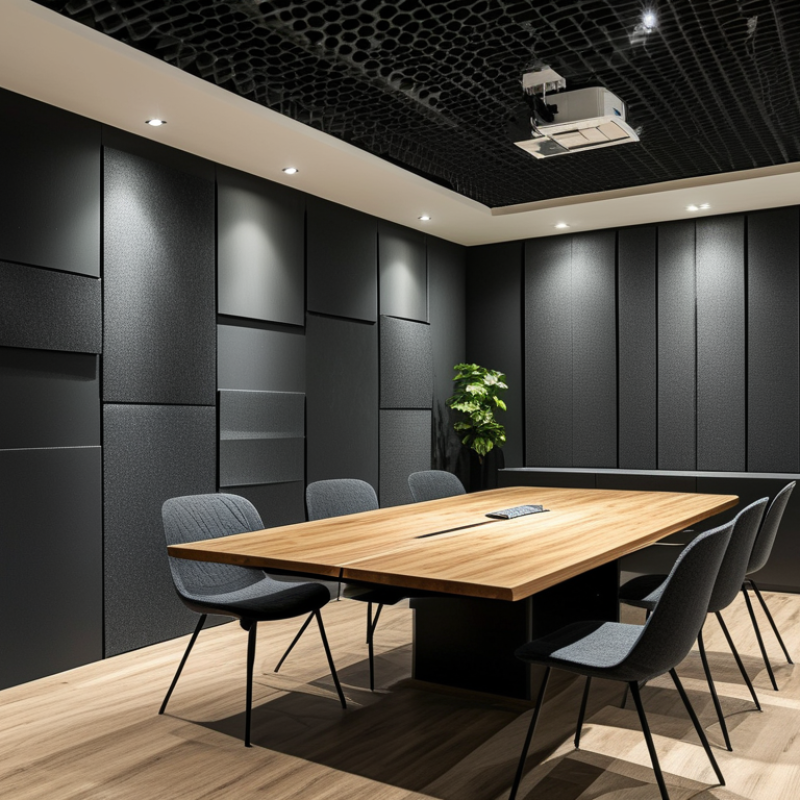
What Black Acoustic Wall Panels Are and How They Control Sound
2026 Top Black Acoustic Wall Panels for Global Buyers
What Black Acoustic Wall Panels Are and How They Control Sound
Black acoustic wall panels are sound-absorbing surfaces, not soundproof barriers. They commonly use porous mineral wool, polyester fiber, or recycled textile cores. A black fabric or felt facing gives rooms a darker, quieter visual character. It can also hide minor dust and surface marks.
Their main job is reducing reflected sound. This helps control speech, keyboard noise, and meeting-room reverberation. ASTM C423 measures sound absorption in laboratories, while ISO 354 evaluates absorption in a reverberation room. The Noise Reduction Coefficient, or NRC, averages absorption at 250, 500, 1,000, and 2,000 hertz. An NRC of 0.80 indicates strong average absorption, but it does not mean eighty percent of every sound disappears.
Placement matters greatly. Panels behind speakers, beside desks, and across large bare walls usually improve speech clarity. Thick panels with an air gap often absorb more efficiently. Low-frequency noise remains difficult. A thin panel will not stop traffic vibration or heavy equipment noise.
The World Health Organization reported over one million healthy life-years lost annually from traffic noise in Western Europe. That figure shows why acoustic comfort deserves serious attention, although wall panels cannot solve outdoor noise alone. Buyers should request laboratory results, thickness, fire-performance documents, and installation details. A perfect-looking installation can still perform poorly. I would question any supplier promising silence from decorative panels. Small room tests remain valuable, because real spaces rarely behave like laboratories.
2026 Top Black Acoustic Wall Panels for Global Buyers - What Black Acoustic Wall Panels Are and How They Control Sound
| Panel Type | How It Controls Sound | Typical Black Surface | Common Thickness | Typical Acoustic Performance | Best Frequency Range | Typical Applications | Key Buying Considerations |
|---|---|---|---|---|---|---|---|
| Black PET Felt Panel | Porous polyester fibers absorb sound energy and reduce reflections, reverberation, and speech flutter echo. | Through-colored or surface-dyed black felt | 9–25 mm | NRC commonly about 0.30–0.80, depending on thickness, density, and air gap | Mid and high frequencies; performance improves with an air cavity | Offices, classrooms, restaurants, corridors, meeting rooms, and home studios | Check recycled-content percentage, edge quality, color consistency, fire classification, and cutting tolerance |
| Black Fabric-Wrapped Fiberglass or Mineral-Fiber Panel | A porous core converts acoustic energy into a small amount of heat while the fabric protects the absorber and provides a decorative finish. | Black polyester, wool-blend, or acoustically transparent textile | 25–100 mm | NRC commonly about 0.70–1.00 when correctly sized and installed | Broadband absorption, including speech frequencies | Conference rooms, auditoriums, cinemas, music rooms, call centers, and open-plan offices | Request test data for the complete panel assembly, fabric lightfastness, cleanability, impact resistance, and fire performance |
| Black Slat Wood Acoustic Panel | Wood slats scatter sound, while the open joints and dark acoustic backing absorb reflected sound behind the slats. | Black-stained, painted, or laminated wood veneer with black backing | 20–45 mm | NRC commonly about 0.35–0.85, strongly affected by spacing and backing thickness | Mid and high frequencies; selected systems can improve lower-frequency absorption with deeper cavities | Hospitality interiors, offices, restaurants, retail spaces, studios, and residential feature walls | Verify timber legality, moisture stability, veneer uniformity, slat spacing, backing material, and wall-fixing method |
| Black Perforated Wood Panel | Perforations allow sound to enter an absorber or cavity behind the face, reducing reflected sound and improving tonal balance. | Black-painted or black-laminated perforated wood-based board | 12–25 mm, excluding cavity | NRC commonly about 0.40–0.85 with suitable backing and air space | Mid frequencies; cavity depth and perforation ratio influence low-frequency response | Lecture rooms, cultural venues, offices, studios, and commercial interiors | Confirm perforation pattern, edge durability, formaldehyde emissions, fire rating, and acoustic results with the specified backing |
| Black Acoustic Foam Panel | Open-cell foam dissipates sound energy through air movement within its pores, primarily controlling reflections and reverberation. | Integral black polyurethane or melamine foam | 25–75 mm | NRC commonly about 0.30–0.80, depending on profile and thickness | Primarily mid and high frequencies | Broadcast rooms, podcast studios, equipment rooms, and controlled recording spaces | Prioritize flame spread and smoke data, odor, UV stability, surface durability, and correct installation spacing |
| Black Bass Trap or Low-Frequency Panel | Deep porous absorption or membrane action reduces low-frequency buildup in corners and along room boundaries. | Black fabric, PET felt, or perforated exterior with an absorptive core | 100–300 mm or more | Performance must be evaluated by frequency; deep systems generally outperform thin decorative panels below 250 Hz | Low and low-mid frequencies, often below 250 Hz | Recording studios, home theaters, cinemas, rehearsal rooms, and control rooms | Ask for octave-band or third-octave test results, not only a single NRC value; confirm corner installation requirements |
| Black Diffuser-Absorber Panel | Combines controlled sound scattering with partial absorption to reduce harsh reflections without making a room acoustically dead. | Black timber, molded composite, or textured PET surface | 50–150 mm | Acoustic results vary by geometry; absorption is commonly moderate rather than maximum | Mid and high frequencies, with diffusion band determined by panel depth | Music studios, listening rooms, theaters, presentation rooms, and premium interiors | Evaluate scattering range, panel orientation, room coverage, installation depth, and visual alignment |
Note: Acoustic values are indicative industry ranges. Actual performance depends on thickness, density, perforation or slat geometry, mounting method, air gap, room conditions, and the test standard used. NRC is a rounded single-number rating and should not be treated as a soundproofing value.
Related Posts
-
Why Choose Square Acoustic Panels for Soundproofing Your Space?
-
How to Choose Acoustic Partition Panels for Your Space?
-
Best Gymnasium Acoustic Panels for Sound Control Solutions?
-
Top 10 Gymnasium Acoustic Panels for Effective Soundproofing?
-
Top Interior Acoustic Panels for Global Buyers to Consider?
-
2026 Best Panel Acoustic Wall Options for Soundproofing Your Space?
-

Phone
-

E-mail
-

wechat
wechat

-

whatsapp
whatsapp