

China Top Slat Wall Acoustic Panel Manufacturers?
Choosing among China’s top Slat Wall Acoustic Panel manufacturers requires more than comparing catalog photos. Buyers should examine material quality, acoustic performance, production experience, and after-sales support. A polished website proves little.
This guide introduces practical ways to assess qualified manufacturers for offices, hotels, studios, restaurants, and residential interiors. It considers core materials, veneer consistency, PET felt density, panel dimensions, fire-performance documentation, and installation guidance. Samples deserve close inspection. Run your fingers across the slats. Check spacing, edge finishing, backing strength, and color consistency under natural light. These small details often reveal production discipline.
Factory experience matters. Reliable suppliers should explain their manufacturing process clearly, provide test reports from recognized laboratories, and answer technical questions without vague promises. Their teams should discuss sound absorption ratings, mounting methods, moisture limitations, maintenance, and project-specific requirements. Ask for references or completed-project evidence when available. A serious manufacturer will also clarify minimum order quantities, lead times, packaging, and replacement procedures.
No ranking is perfect. Market information changes. Some manufacturers have strong acoustic testing but limited design flexibility, while others offer attractive customization with weaker documentation. That gap deserves attention. The best choice depends on your room, budget, performance target, and installation conditions. This overview aims to support careful comparison, not promote one supplier blindly. Measure twice. Specify clearly. Then request physical samples before approving a large order.
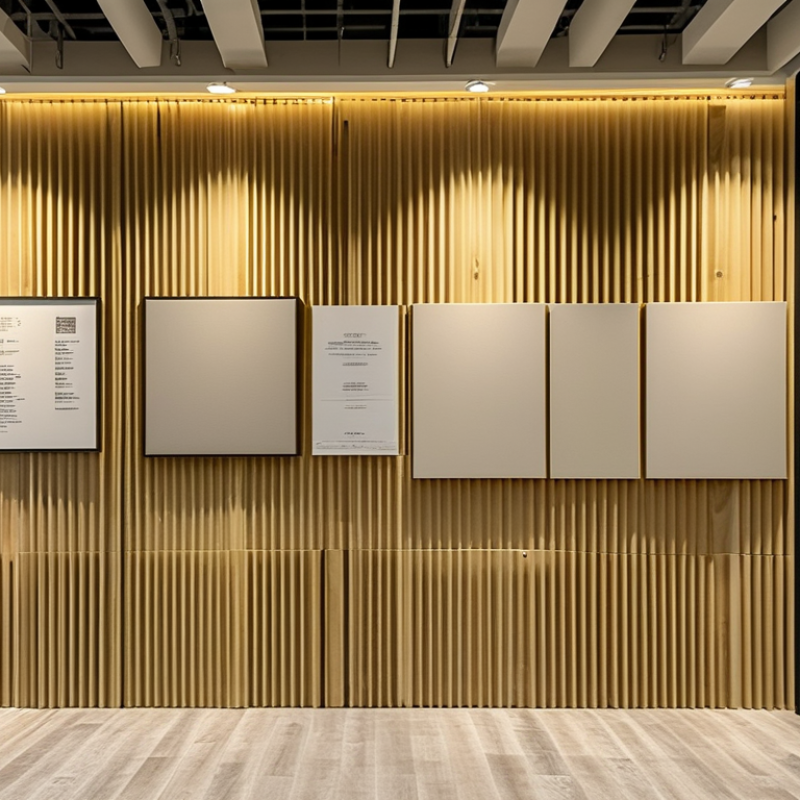
What Are Slat Wall Acoustic Panels and How Do They Work?
China Top Slat Wall Acoustic Panel Manufacturers?
What Are Slat Wall Acoustic Panels and How Do They Work?
Slat wall acoustic panels combine narrow wood slats with an absorbent backing layer. The slats add structure, while the backing usually contains recycled felt or mineral-based acoustic material. Small gaps between the slats let sound waves reach this softer layer. There, part of the sound energy becomes low-level heat through friction. The room feels calmer.
These panels mainly reduce reflected speech, music, and office noise. They do not fully block sound between rooms. That distinction matters. In a meeting room, panels behind speakers can reduce harsh echoes and improve voice clarity. A simple test uses hand clapping. If the sound lingers, the room probably needs more absorption. Ceiling treatment may still be necessary.
Installation details affect real performance. A small air gap behind the panel can improve low-frequency absorption, although the result depends on panel thickness and spacing. Covering one wall may look attractive but deliver limited acoustic change. Balanced placement usually works better. Avoid treating every surface, or the room may feel unnaturally dull. I have seen attractive installations underperform because installers ignored windows, floors, and ceiling height. Product data should include sound absorption results from recognized laboratory testing, not vague claims. Even then, furniture and room use can change the final experience.
| Evaluation Dimension | Typical Product or Manufacturing Data | How It Works or Why It Matters | Recommended Verification Item |
|---|---|---|---|
| Basic Panel Construction | Decorative wood veneer or laminate slats fixed to an acoustically transparent PET felt or mineral-fiber backing. | The narrow gaps between slats allow sound energy to reach the porous backing, where air movement is converted into a small amount of heat and reflected sound is reduced. | Confirm the slat material, backing composition, adhesive type, and complete assembly structure. |
| Common Slat Dimensions | Slat widths commonly range from approximately 20–40 mm, with gaps often between 10–20 mm. Actual dimensions vary by design. | Slat width and spacing affect the visible appearance, open area, and the frequency range that can enter the absorbing layer. | Request approved production drawings and tolerance specifications before mass production. |
| Panel Thickness | Common finished thicknesses are approximately 20–50 mm, excluding optional wall cavities or additional insulation. | Greater thickness generally provides more absorption potential, especially when the panel is combined with an air gap behind it. | Check the total installed depth, including battens, rails, clips, and any cavity insulation. |
| Acoustic Absorption Rating | Typical slat-panel assemblies may achieve an NRC of approximately 0.45–0.95, depending on panel construction, thickness, spacing, and installation. | NRC is a single-number indicator of sound absorption averaged over selected mid-frequency bands. A higher value usually means less reflected sound in the tested range. | Ask for an independent laboratory test report using the exact panel assembly and installation method being supplied. |
| Frequency Performance | Porous backing is generally effective at mid and high frequencies. Low-frequency absorption improves with increased thickness and a deeper air cavity. | Speech intelligibility and reverberation control often depend more on mid-frequency absorption, while music and mechanical noise may require broader frequency treatment. | Review octave-band or one-third-octave test results instead of relying only on an NRC value. |
| Backing Material | Common options include PET acoustic felt, polyester fiber, mineral fiber, or other porous sound-absorbing substrates. | The backing controls much of the panel’s absorption performance and can also affect weight, fire behavior, moisture resistance, and recyclability. | Verify density, thickness, recycled content, formaldehyde emissions, moisture resistance, and fire test documentation. |
| Mounting Configuration | Typical systems include direct wall fixing, concealed clips, timber battens, metal rails, or a framed cavity installation. | An air gap behind the panel can improve low-frequency absorption and may simplify cable routing and leveling during installation. | Confirm substrate requirements, fixing intervals, edge details, joint treatment, and maximum panel weight per fixing point. |
| Fire Performance | Fire classification depends on the complete finished assembly, including slats, backing, coating, adhesive, and mounting method. | A fire rating for one component cannot automatically be applied to the entire installed wall or ceiling system. | Request a valid fire test or classification report for the exact product configuration and target market standard. |
| Surface and Finish Options | Common finishes include natural wood veneer, stained veneer, painted surfaces, melamine, high-pressure laminate, and printed decorative finishes. | The finish affects visual appearance, cleanability, scratch resistance, light reflectance, and sometimes acoustic transparency. | Check color consistency, veneer matching, coating durability, odor, VOC emissions, and sample approval procedures. |
| Dimensional Accuracy | Important controls include panel length, width, thickness, slat spacing, squareness, edge straightness, and backing alignment. | Consistent dimensions help prevent visible joint irregularities and reduce installation time on large wall or ceiling areas. | Define measurable tolerances in the purchase specification and inspect production samples before shipment. |
| Environmental and Indoor-Air Data | Relevant documentation may include recycled-content information, product emissions testing, responsible wood sourcing, and waste-management procedures. | Acoustic panels are frequently installed in offices, schools, hotels, studios, and other occupied interiors where emissions and material transparency matter. | Request current certificates or test reports accepted in the destination market, rather than general marketing statements. |
| Quality-Control Process | Standard controls may include incoming-material inspection, veneer or finish inspection, dimensional checks, adhesive-bond checks, packaging inspection, and final sampling. | Consistent process control reduces color variation, delamination, warped slats, damaged edges, and mismatched panel joints. | Confirm inspection checkpoints, sampling standards, corrective-action procedures, and pre-shipment inspection rights. |
| Typical Applications | Offices, conference rooms, classrooms, libraries, hospitality interiors, restaurants, home theaters, recording spaces, and public reception areas. | Slat wall acoustic panels combine decorative wall treatment with reverberation control; they do not normally provide complete sound isolation between rooms. | Determine whether the project requires absorption, sound insulation, impact resistance, moisture resistance, or a combination of these functions. |
| Manufacturer Selection Priority | Tested performance Stable quality Documented materials Reliable installation system | A capable supplier should demonstrate repeatable product quality and provide technical evidence for acoustics, fire safety, emissions, and installation performance. | Compare complete assemblies, not isolated material samples or unsupported performance claims. |
Related Posts
-

2026 Top Slat Wall Acoustic Panel Manufacturers?
-

2026 Best Fluted Acoustic Panels for Global Buyers
-

Best Grooved Acoustic Panels for Soundproofing Solutions?
-
How to Choose the Best Black Acoustic Wall Panels for Your Space?
-
2026 Best Panel Acoustic Wall Solutions for a Quiet Space?
-

Exploring Alternatives to Fluted Acoustic Panels: A Comprehensive Analysis of Soundproofing Solutions
-

Phone
-

E-mail
-

wechat
wechat

-

whatsapp
whatsapp