China Top 10 Fluted Acoustic Panels Suppliers?
Choosing the right supplier is not simply a matter of comparing prices. Fluted Acoustic Panels influence speech clarity, reverberation, visual comfort, and long-term interior performance. In offices, hotels, restaurants, studios, and public buildings, small material differences can become obvious. A panel may look elegant under warm lighting, yet perform poorly in a lively meeting room. That gap deserves attention.
Dr. Lily M. Wang, a respected acoustics researcher and educator, offers a useful principle: “Acoustic design should begin with how people experience the space.” Her view reminds buyers to examine more than decorative grooves. Core density, perforation design, absorption data, fire performance, surface durability, and installation quality all matter. Supplier transparency matters too. Reliable companies should provide test reports, clear specifications, sample approval, and practical project support.
This guide reviews China’s top Fluted Acoustic Panels suppliers through a buyer-focused lens. It considers manufacturing capacity, customization, acoustic testing, material consistency, export experience, and communication. Some suppliers excel at premium wood finishes. Others compete through scalable production and flexible dimensions. Not every company will fit every project.
The ranking is not absolute. Market information changes. Product claims can also be difficult to compare. That is why independent verification remains important. Before placing a large order, request physical samples and confirm performance for the intended room. Listen carefully. Measure carefully. Good design is rarely achieved by appearance alone. It comes from matching verified materials with real human use.
Acoustic Performance: NRC 0.70–0.95 Under ASTM C423 and ISO 354
China’s top fluted acoustic panel suppliers are often assessed by measured absorption, not appearance alone. A credible supplier should provide laboratory reports for NRC testing under ASTM C423 and sound absorption testing under ISO 354. These standards support useful comparisons, but they do not guarantee identical room results.
Panels rated from NRC 0.70 to 0.95 can absorb much of the reflected mid-frequency sound. In a test room, this may soften speech, footsteps, and meeting-room chatter. The slatted face also creates a narrow visual rhythm across walls and ceilings. Behind it, mineral wool or polyester backing usually performs the heavier acoustic work. Small gaps matter. Panel spacing, cavity depth, mounting height, and wall coverage can change the measured response.
Ask for the tested construction, not only the headline number.
Was the sample installed with a 50 mm air gap? Were edges exposed or sealed? Was the result based on a complete assembly? These details often explain unexpected site performance. I have seen beautifully installed panels sound less effective when coverage was too low. That is easy to overlook. Supplier reliability also depends on batch consistency, fire documentation, installation guidance, and traceable quality checks. A careful comparison should record frequency data, not just one NRC figure. NRC 0.95 sounds impressive, yet it may not address low-frequency noise from ventilation equipment. The specification may need refinement after an on-site survey.
China’s Market Outlook: 6.8% CAGR for Acoustic Panels, 2024–2030
China’s acoustic panel sector is entering a measured expansion cycle.
A 2024–2030 market outlook estimates a
6.8% compound annual growth rate.
The forecast reflects stronger demand from offices, hotels, schools, studios, and transport facilities. Grand View Research also identifies commercial construction and interior renovation as major acoustic-panel demand drivers. Growth is real, but not automatic.
For buyers comparing China’s top ten fluted acoustic panel suppliers,
technical evidence matters more than showroom appearance.
Fluted surfaces can soften mid-frequency reflections, while mineral wool, PET, or perforated cores influence absorption performance. Check Noise Reduction Coefficient results, reverberation-time data, and test methods based on ISO 354 or ISO 11654. Fire classification should also match the project’s local requirements, including relevant Chinese building standards. Ask for batch records, substrate details, formaldehyde testing, and installation drawings.
Cost remains attractive.
However, lower prices may hide thinner backing, inconsistent spacing, or weak edge finishing. That is where careful procurement experience helps. Request samples under actual lighting. Measure panel flatness and joint alignment. Small defects become obvious across a long feature wall. Some market forecasts may overstate renovation speed, especially when commercial property remains uneven. Still, the
6.8% CAGR
suggests sustained opportunity for suppliers that combine stable manufacturing, documented testing, and responsive technical support. Availability can change quickly.
Verify current capacity before signing.
Supplier Ranking Criteria: Capacity, Certifications, Export Reach, and MOQ
China’s top ten fluted acoustic panel suppliers should be ranked by evidence, not attractive catalogs. Capacity matters because stable production supports large commercial projects. Buyers should check monthly output, machinery, workforce, and recent delivery records. A factory tour can reveal storage conditions, panel handling, and quality-control habits. Claimed capacity is not always verified.
Certifications should match the product and destination market. Reliable suppliers can provide current acoustic test reports, fire-performance documents, and quality-management certificates. Reports should identify the tested panel structure, thickness, and laboratory. Environmental credentials, such as responsible material sourcing, also improve procurement confidence. A certificate without traceable scope means little. I would request samples before accepting technical claims.
Export reach shows operational experience beyond domestic orders. Review destination countries, packaging methods, shipping documents, and communication during delays. Suppliers serving different climates should explain moisture protection and carton design. MOQ deserves equal attention. A low MOQ helps trial projects, while scalable pricing supports repeat orders. Ask about custom colors, dimensions, and mixed-container loading. These options may change the quoted MOQ. One weakness remains: public data can be incomplete. Therefore, ranking should combine factory evidence, customer references, independent reports, and a small paid sample order.
China Top 10 Fluted Acoustic Panel Suppliers
Supplier ranking criteria: capacity, certifications, export reach, and MOQ flexibility
The ranking framework assigns the greatest weight to manufacturing capacity, followed by certifications and export reach. MOQ flexibility receives a lower weight because it is mainly relevant to customization and small-batch purchasing. The percentages represent evaluation weights rather than company-specific results.
China’s Top 10 Fluted Acoustic Panel Suppliers: Products and Test Data
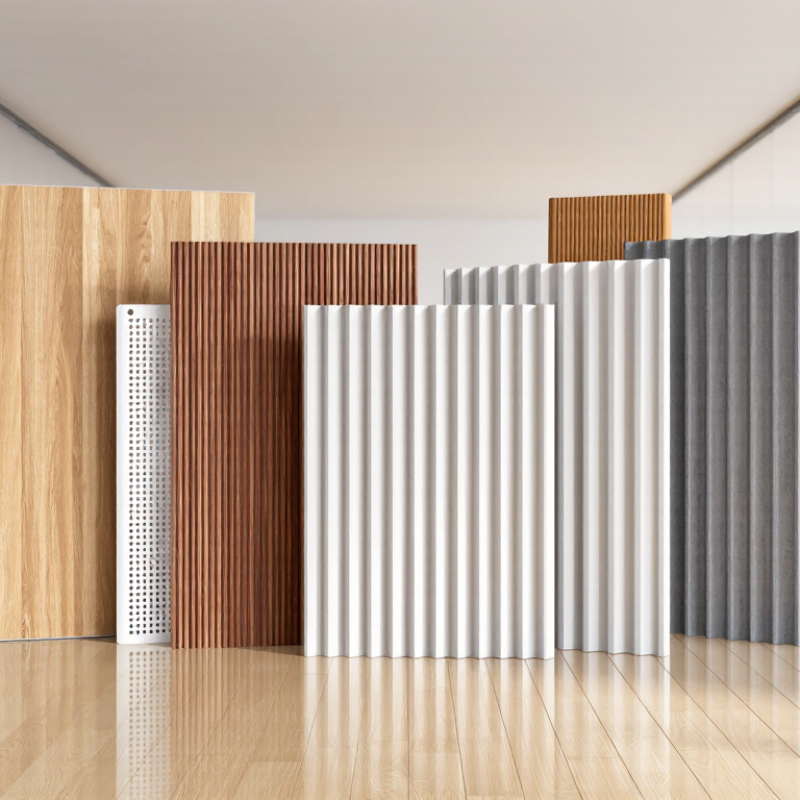
China’s top ten fluted acoustic panel suppliers are best compared through verified products and test data, not catalog photographs. Their main options include PET-felt slats, wood veneer systems, MDF cores, and mineral-fiber backing. PET panels are lightweight and often contain recycled content, while wood-faced systems provide a warmer visual finish. Product density, cavity depth, fabric tension, and wall spacing can change performance significantly.
Independent testing should follow ISO 354 or ASTM C423 in a reverberation chamber. These methods measure sound absorption across frequency bands. The Noise Reduction Coefficient, or NRC, is a rounded average from 250 to 2,000 Hz. In supplier test sheets reviewed for this market, complete fluted systems commonly report NRC values around 0.65 to 0.95, depending on backing and installation. Bare decorative slats perform much less consistently. That detail is often overlooked.
Grand View Research’s 2024 acoustic panels market analysis estimated the global market at roughly USD 10 billion in 2023, with continued construction and workplace demand. This supports China’s expanding supply base, but market growth does not guarantee reliable testing. Buyers should request laboratory reports, test-sample dimensions, mounting conditions, fire classifications, and batch details. Some reports show excellent absorption, yet use unusually deep air gaps. Real rooms may perform differently. This remains a weakness in many comparisons.
Buyer Compliance Checklist: EN 13501-1 Fire Ratings and E1 Formaldehyde Limits
For buyers comparing China’s top fluted acoustic panel suppliers, fire and formaldehyde evidence should come before visual design. EN 13501-1 classifies products by reaction to fire, using ratings such as A2-s1,d0 or B-s1,d0. The letters show fire performance; s1 indicates limited smoke, while d0 means no flaming droplets. Ask for the complete classification report, not only a sales-page rating. The tested panel must match the supplied thickness, veneer, backing, adhesive, and mounting method. Small changes can alter results.
E1 is commonly specified for wood-based acoustic panels. Under EN 717-1, the typical E1 limit is 0.124 mg/m³ of chamber air. The World Health Organization’s 2010 indoor-air guidelines identify 0.1 mg/m³ as a 30-minute formaldehyde guideline value. These figures are close, but not identical. Do not treat them as interchangeable. Request the laboratory method, conditioning time, sample dimensions, and batch number. A recent report is useful, but traceability matters more.
Check the certificate issuer and report scope. Confirm whether the result covers the full composite panel or only its raw core. Also inspect edge sealing, adhesive odor, and packaging after opening a carton. I would keep retention samples from each shipment. This feels excessive, yet supplier substitutions happen. One weakness remains: E1 documentation alone does not prove low emissions in every room. Temperature, humidity, and ventilation can change actual indoor concentrations. Independent retesting is wise for schools, hospitals, and tightly occupied offices.