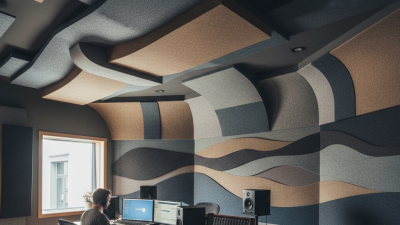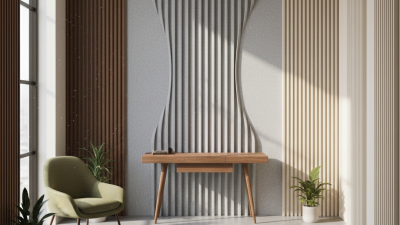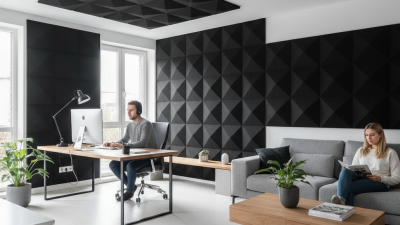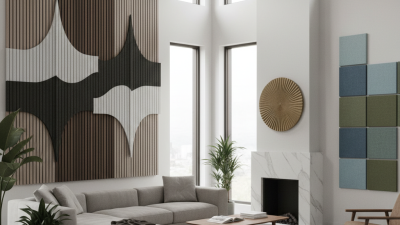

China’s growing interior construction sector is increasing demand for quieter, more adaptable spaces. Curved Acoustic Panels help control reverberation while adding visual movement to ceilings, walls, and feature installations. They suit offices, hotels, restaurants, schools, studios, and public buildings.
The World Health Organization identifies environmental noise as a significant public health concern. Its guidance also emphasizes suitable indoor sound conditions for learning, communication, and rest. In practice, a hard room can create sharp echoes from speech, footsteps, and equipment. A well-positioned curved panel softens these reflections. The result is often clearer conversation and a calmer acoustic environment.
Measurement still matters.
According to ISO 354, sound absorption should be tested in a reverberation room. ISO 3382 supports reverberation-time evaluation in rooms such as classrooms and offices. ASTM C423 provides another widely recognized method for measuring sound absorption. These standards help manufacturers compare materials more reliably. They do not replace project-specific acoustic design.
As a China Top Curved Acoustic Panels Manufacturer, our approach combines CNC forming, fabric selection, edge finishing, and documented quality inspection. We can develop panels with mineral wool, PET felt, or other engineered cores, depending on fire, durability, and absorption requirements. Dimensions, radius, suspension details, and mounting conditions affect performance. A beautiful panel cannot fix every acoustic problem. That is easy to forget.
We recommend reviewing room volume, occupancy, reverberation targets, and installation drawings before production. Sample testing remains valuable, especially for large halls and irregular ceilings. Our experience supports practical customization, but each project still deserves careful acoustic verification.
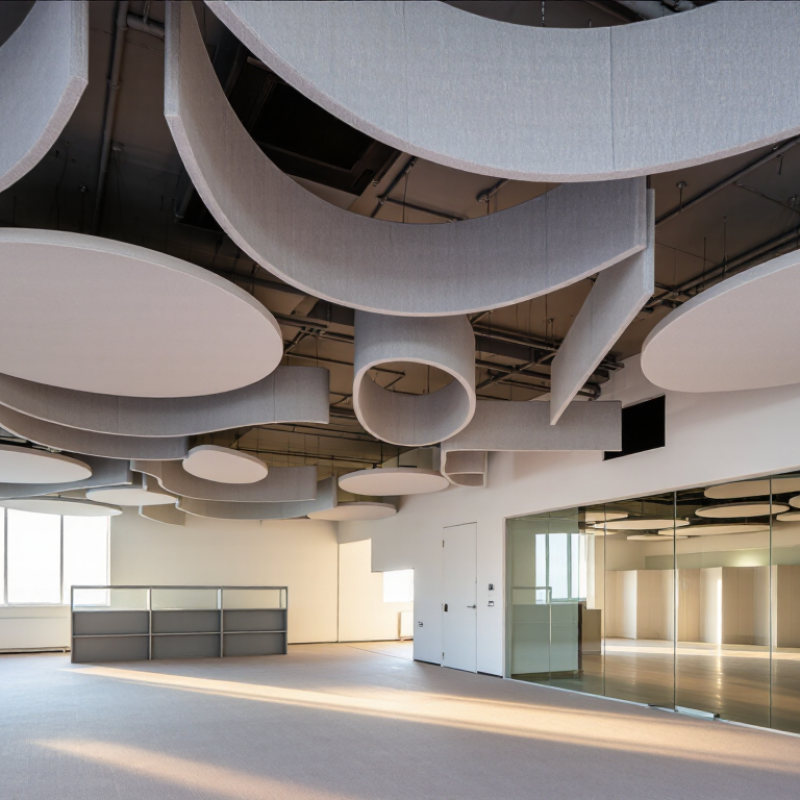
Curved acoustic panels shape sound as well as space. Convex panels scatter reflections across wide areas, reducing harsh echoes in meeting rooms and halls. Concave panels focus sound, so they require careful placement near speech zones. Wave-shaped panels combine both effects and create a softer visual rhythm.
Their core materials determine performance. Fiberglass and mineral wool offer strong absorption across mid and high frequencies. They are often wrapped in breathable fabric and fitted inside a shaped frame. Recycled PET felt is lightweight, moisture-resistant, and easy to thermoform into flowing curves. Perforated wood panels usually use mineral wool behind plywood or MDF. The wood surface adds warmth, while the hidden core absorbs sound.
Foam cores are light and flexible, but their low-frequency performance can be limited. Fire ratings also need verification before installation. In practical projects, I check reverberation, panel spacing, and mounting strength together. A beautiful curve can fail if it leaves air gaps or faces the wrong direction. Small design mistakes matter. Room measurements should guide the final radius, thickness, and coverage. Independent acoustic and fire test reports provide more reliable evidence than appearance alone.
The chart compares representative Noise Reduction Coefficient (NRC) values for common acoustic panel core materials. Fiberglass and mineral wool typically provide higher broadband absorption, while PET felt and perforated wood cores offer a balance of acoustic performance, design flexibility, and lower weight. Convex, concave, and wave-shaped panels can be manufactured with these cores; the final NRC depends on thickness, fabric, air gap, perforation, and installation method.
Values shown are representative midpoints of commonly published NRC ranges and are intended for general comparison rather than project-specific acoustic certification.
Curved acoustic panels manage sound by shaping reflection paths inside a room. Unlike flat panels, their rounded surfaces can scatter mid and high frequencies across wider areas. This reduces harsh echoes without making the room feel acoustically dead. In meeting rooms, curved panels can improve speech clarity near tables, walls, and presentation zones. In studios or public halls, they help control flutter echo between parallel surfaces.
Their performance depends on more than curvature. Panel density, thickness, perforation, and fabric covering all influence absorption. A convex panel can spread reflected energy, while a concave design may focus sound if positioned poorly. That detail matters. Professional installers should review room dimensions, reverberation time, and noise sources before selecting a layout. Measuring the space is more reliable than copying a standard pattern.
During practical installations, small adjustments often produce better results. Rotating one panel can reduce a bright reflection near a microphone. Leaving controlled gaps behind panels can improve low-frequency absorption. Still, curved panels are not a complete solution for heavy bass or exterior noise. They work best with ceiling treatment, wall absorption, and careful furniture placement. Results can vary between rooms, so testing remains necessary. A visually impressive design may sound uneven if acoustic data is ignored.
Curved acoustic panels begin with a measured acoustic and architectural brief. Engineers review room volume, reverberation targets, wall radii, and fire requirements. Samples are cut from certified substrates, acoustic infill, and selected surface fabrics. A full-size mock-up often reveals problems that drawings miss. Small errors matter.
At a Chinese manufacturing facility, technicians prepare the core material before forming. Depending on the radius, panels may use layered wood, molded fiber, or flexible composite boards. Controlled pressure shapes each panel around a custom mold. Moisture content and panel thickness are checked during production. Panels then rest before CNC trimming begins. This reduces unwanted movement after installation.
CNC machines create accurate edges, fixing points, and service openings. Workers inspect the curve by placing each panel against a reference template. Fabric is stretched carefully, because loose areas can affect appearance and sound absorption. Finished pieces undergo dimensional checks, surface inspection, and acoustic testing when required. Packaging includes corner protection and clear installation marks.
The difficult part is repeatability. Natural wood can react differently between batches. Even stable materials may show slight spring-back after forming. Experienced teams adjust pressure, curing time, and trimming allowances instead of hiding these differences. That practice is not perfect, but it is honest manufacturing. Reliable production depends on documented checks, traceable materials, and communication between engineers, technicians, and installers.
A top curved acoustic panels manufacturer must prove performance, not merely display attractive samples. ISO 354 measures sound absorption in a reverberation room. ASTM C423 reports the Noise Reduction Coefficient, or NRC. These tests reveal how panels perform across frequencies. A reliable factory should provide laboratory reports, panel density, thickness, fire rating, and installation conditions. ISO 11654 also classifies absorption through the weighted sound absorption coefficient, αw. One impressive number is not enough.
Design must follow the room’s acoustic problem. Curved panels can soften reflections across ceilings, walls, and columns. In offices, speech clarity matters more than maximum absorption. In auditoriums, low-frequency control needs thicker materials or an air cavity.
The World Health Organization recommends indoor bedroom noise below 30 dB(A) at night for good sleep. Panels cannot solve every noise source, but careful placement can reduce reverberation and improve comfort. Real projects need before-and-after measurements. Small installation gaps may change the result.
Tips: Ask for third-party test reports, not only factory claims. Check ASTM C423 or ISO 354 results. Confirm fire, moisture, and formaldehyde documentation. Request a sample installation. I would also question unusually high NRC values without frequency data. That weakness is easy to miss. A capable manufacturer should explain limits honestly, provide traceable quality records, and inspect panel curvature, edge finish, color consistency, and mounting hardware before shipment.
Curved acoustic panels suit spaces where flat surfaces cannot control reflections effectively. They work well in atriums, restaurants, classrooms, studios, open offices, and transport interiors. Their shaped surfaces can interrupt flutter echoes and soften harsh speech reflections. However, curved does not automatically mean acoustically superior.
Selection should begin with the room’s use and measured reverberation time. ISO 354 defines laboratory methods for measuring sound absorption, while ISO 11654 classifies absorption through the weighted absorption coefficient, αw. A panel with strong mid-frequency absorption may improve speech clarity, yet leave low-frequency noise almost unchanged. Check the test frequency range, not only one headline rating.
Room geometry matters. In a 3.5-metre-high classroom, suspended curved panels can reduce ceiling reflections without blocking lighting or sprinklers. In a restaurant, washable fabric and impact resistance may matter more than maximum absorption. The World Health Organization’s 2018 environmental noise guidelines recommend indoor bedroom levels below 30 dB(A) at night for good sleep. That figure is useful, but it cannot replace site measurements. Consider panel radius, spacing, air gaps, mounting direction, fire classification, humidity, and maintenance access. Small design mistakes remain common. An attractive panel may still perform poorly when installed too close to a hard ceiling.