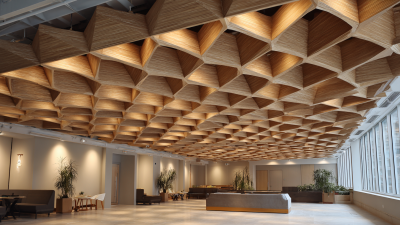

Choosing a China Best Acoustic Wood Ceiling Panels Supplier requires more than comparing prices, finishes, and export claims. Acoustic Ceiling Wood must balance sound absorption, fire performance, durability, installation quality, and responsible sourcing. A beautiful slatted ceiling can still perform poorly if its backing layer, cavity depth, or panel spacing is unsuitable.
Industry demand is growing. Grand View Research places the global acoustic panels market at approximately USD 12 billion in 2023, with continued growth expected through 2030. MarketsandMarkets also identifies commercial offices, education, hospitality, and healthcare as important application sectors. These reports generally cover acoustic panels, not wood ceilings alone. The numbers are not perfect. They should guide research, not replace technical verification.
Acoustician Leo Beranek is often associated with the principle, “Good acoustics is not an accident.” That idea remains practical when evaluating Chinese suppliers. Ask for independent laboratory results, absorption coefficients, fire-test documents, formaldehyde-emission information, and project references. Check whether the reported NRC value applies to the complete ceiling system, not only the decorative wood surface. Request samples under real lighting, because veneer color and perforation alignment can change the final impression. Supplier communication matters, too. A factory may offer excellent machinery yet provide weak drawings or unclear tolerances. Reliable sourcing needs both engineering evidence and experience. The best supplier is not always the cheapest one. Sometimes, the quietest decision is the most carefully checked.
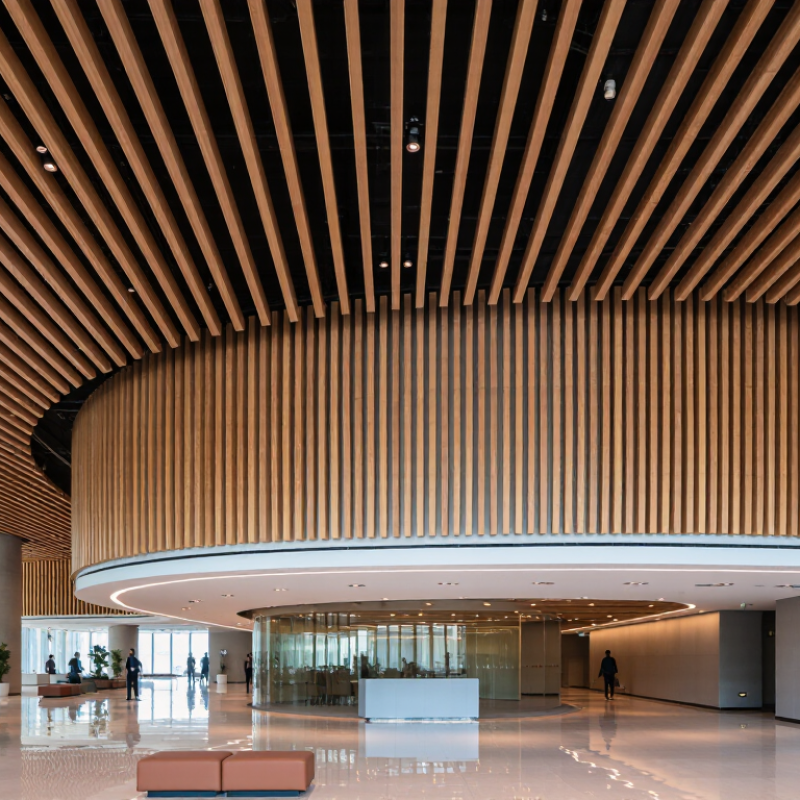
Acoustic wood ceiling panels combine a visible timber surface with an absorptive backing, such as mineral wool or recycled-fiber felt. Small slots or perforations let sound pass through the wood and reach that backing. The fibers convert some sound energy into heat, reducing reflections. Less echo. Solid, unperforated boards mostly reflect sound, so appearance alone does not indicate acoustic performance.
Performance depends on panel depth, perforation pattern, backing, and installation. The Noise Reduction Coefficient (NRC), measured under ASTM C423, summarizes absorption across key frequencies; compare tested values, not claims based only on material type. The World Health Organization’s Guidelines for Community Noise recommend classroom background noise below 35 dB LAeq during teaching. Absorptive ceilings can help control reverberation, but they do not block outside noise like a sealed, insulated wall. That distinction is easy to miss.
For a practical check, ask for laboratory test data and confirm whether results include the specified air gap and backing. A shallow cavity may absorb less low-frequency sound than a deeper assembly. Site conditions matter, too: hard floors and glass walls can still create audible reflections. A room can feel quieter without becoming truly quiet. Testing a sample in the actual ceiling build-up is more reliable than judging a small showroom display.
China Best Acoustic Wood Ceiling Panels Supplier?
Key Materials and Designs Used in Wood Ceiling Panels
Acoustic wood ceiling panels often combine a perforated timber face, a dark acoustic fleece, and a mineral or polyester core. Oak, ash, and walnut offer different grain patterns, hardness, and color depth. Veneer keeps the surface authentic while reducing material use. Solid wood feels warmer, but it can be heavier and more sensitive to humidity.
During project inspections, I look closely at perforation size, panel thickness, and edge quality. Small holes create a refined rhythm. Larger openings usually expose more backing and improve sound absorption. Slatted panels add direction to a room, while linear grooves can visually stretch a low ceiling. Curved modules need accurate machining. Minor alignment errors become obvious under downlights.
Fire rating, formaldehyde emissions, moisture resistance, and acoustic test data should be verified before ordering. A reliable supplier should provide test reports, installation drawings, and clear tolerances. I have seen attractive samples fail when the backing was poorly bonded. That detail matters. Ceiling access also deserves attention. Removable sections may reduce visual continuity, but they make maintenance easier. Designers sometimes choose perfect symmetry, yet real rooms rarely support it. A slightly varied layout can hide structural obstacles, though it requires careful planning.
The chart compares representative midpoints of typical Noise Reduction Coefficient (NRC) ranges used for common wood ceiling panel designs. Slatted and perforated panels generally provide better sound absorption when combined with mineral wool or acoustic fleece backing, while solid wood panels mainly contribute visual warmth and have limited sound absorption without an acoustic backing layer.
Choosing China’s best acoustic wood ceiling panel supplier requires more than comparing prices. Grand View Research estimated the global acoustic panels market would grow at about 7% annually through 2030. That growth attracts capable factories, but also inconsistent suppliers. Request laboratory reports for sound absorption, fire reaction, and formaldehyde emissions. Reliable documents should identify test standards, sample thickness, panel spacing, and laboratory accreditation.
Check performance under recognized methods, such as ASTM C423 or ISO 354. A high NRC value may look impressive, yet installation gaps can change real results. Ask for production samples, not only showroom pieces. Inspect veneer alignment, edge finishing, slat spacing, backing density, and moisture resistance. Compare the approved sample with random cartons from production. Small differences often appear there. For fire classification, confirm the required standard for your destination market, such as ASTM E84 or EN 13501-1.
Tips: Ask suppliers for three recent project references, batch inspection records, and packaging photographs. Verify whether testing covers the exact panel construction you will purchase. A beautiful sample can mislead. Treat it as a starting point, not proof. Also review lead times, replacement policies, and technical support in writing. Some factories provide strong acoustic data but weak quality control. Others communicate well but lack independent testing. The safest evaluation combines factory visits, third-party inspection, documented tests, and a small pilot order before full production.
| Evaluation Dimension | What to Request | How to Verify | Warning Signs | Score (1–5) |
|---|---|---|---|---|
| Acoustic performance | Test reports for the proposed panel construction, including the tested panel, backing, air gap, and mounting method. | Check the test standard, laboratory, sample description, test date, and reported results. Compare configurations that match the planned installation. | An NRC or absorption claim is provided without a report or without details of the tested assembly. | ___ / 5 |
| Fire performance | Fire-test documentation for the exact panel build-up, including veneer, core, finish, and any acoustic backing. | Confirm that the classification and test method meet the requirements for the project location and intended application. | A certificate covers a different material or assembly, or the supplier presents a rating without identifying its scope. | ___ / 5 |
| Materials and emissions | Panel composition, core and backing details, applicable emissions documentation, and safety data for adhesives or coatings where relevant. | Match document names and product descriptions to the quoted specification. Check whether requirements apply to the destination market. | Material descriptions are vague, or documents cannot be linked to the proposed product. | ___ / 5 |
| Dimensions and tolerances | Available panel sizes, thicknesses, edge details, dimensional tolerances, and installation drawings. | Review a dimensioned drawing and inspect samples or a first-article panel against agreed requirements. | Critical dimensions and allowable variation are not recorded in the quotation or technical specification. | ___ / 5 |
| Finish and consistency | Samples showing veneer species or finish, perforation or slot pattern, edge treatment, and color range. | Approve a reference sample and define acceptable variation for natural wood grain and color before production. | Production is promised to match a small sample exactly despite natural variation, with no agreed approval process. | ___ / 5 |
| Quality control | Inspection stages, inspection records, defect criteria, and procedures for handling nonconforming products. | Ask for sample inspection records and agree on checks for dimensions, finish, damage, and order quantity. | Quality assurances are verbal only, or inspection criteria are not defined before production. | ___ / 5 |
| Production capacity and lead time | Written production schedule, stated capacity for the required order, and estimated dispatch date. | Compare the schedule with sample approval, production, inspection, and shipping milestones; confirm what could affect timing. | Lead time is given without a production plan or changes after key specifications are confirmed. | ___ / 5 |
| Packaging and transport | Packaging specification, pallet or carton details, protection for edges and finishes, and shipping terms. | Confirm packaging is suitable for the panel dimensions, handling route, and destination requirements; clarify responsibility under the agreed trade term. | Packaging details and responsibility for transit damage are not agreed in writing. | ___ / 5 |
| Commercial clarity | Itemized quotation covering specifications, quantities, tooling or setup costs, payment terms, sample costs, and validity period. | Check that the quotation, drawings, approved sample, and purchase order describe the same product and scope. | Important costs, exclusions, or specification changes are left open to interpretation. | ___ / 5 |
| Communication and after-sales support | A named project contact, response process, installation guidance, and a written procedure for claims or replacement parts. | Track response times during sampling and clarify how issues will be documented and resolved after delivery. | Questions about technical details or corrective actions receive unclear or inconsistent answers. | ___ / 5 |
A reliable acoustic wood ceiling panel supplier should prove its manufacturing discipline, not only display attractive finishes. Production begins with stable timber, controlled moisture, and documented material sources. Panels are checked before machining, because damp wood can later warp or open at the joints. Small defects matter.
Factories should control perforation size, spacing, panel thickness, and edge alignment. Digital measurements help, but experienced inspectors still examine the surface under strong, angled light. This reveals chipped veneer, uneven color, and loose acoustic fleece. Each batch should include dimensional checks and traceable inspection records. Random sampling is useful, but it can miss isolated failures.
Performance testing must match the intended installation. Independent laboratories can assess sound absorption under ISO 354 or ASTM C423 methods. Fire classification should follow the requirements of the target market, such as EN 13501-1 where applicable. Formaldehyde emissions and adhesive safety also deserve documented testing. The suspension system needs inspection for load capacity, corrosion resistance, and secure connections.
In real projects, factory checks should continue after packing. Inspectors can measure cartons, verify protective corners, and photograph finished pallets before shipment. Yet no system is perfect. A panel may pass laboratory testing and still perform poorly when installers leave open gaps. Clear installation guidance, batch records, and responsive technical support make quality more dependable. Listening to site feedback can reveal problems that factory data overlooks.
China Best Acoustic Wood Ceiling Panels Supplier?
Selecting an acoustic wood ceiling supplier starts with measurable performance, not attractive photographs. Grand View Research valued the global acoustic insulation market at about USD 14.5 billion in 2023, with steady growth forecast through 2030. This growth increases supplier choices, but also increases inconsistent claims. Request absorption results under ISO 354 or ASTM C423. Check the Noise Reduction Coefficient, fire classification, panel thickness, perforation rate, and backing material. A supplier should explain each figure clearly.
Review samples in a real room. Tap the panel, inspect the veneer edges, and check the suspension hardware. Ask for production tolerances, moisture resistance data, and batch inspection records. EN 13964 can help when evaluating suspended ceiling systems. Compare factory capacity with your project quantity and delivery window. A low quotation may hide weak packaging, unstable color matching, or expensive replacement shipments. A mistake worth admitting: many buyers compare price before confirming installation details.
Tips: Request two samples from different batches. Test them beside your lighting. Ask for recent laboratory reports, not edited screenshots. Audit the factory through live video or an independent inspection. Confirm payment terms, Incoterms, spare panels, and corrective-action procedures. Use a written specification sheet. It prevents quiet changes after approval. The 2024 Dodge Construction Network report also indicates that material availability and supply-chain reliability remain major construction concerns. Choose the supplier that documents control, not merely the one that promises speed.